
Natural Language Processing Week 1 NPTEL Assignment Answers 2026
Need help with this week’s assignment? Get detailed and trusted solutions for Natural Language Processing Week 1 Assignment Answers Our expert-curated answers help you solve your assignments faster while deepening your conceptual clarity.
✅ Subject: Programming In Java
📅 Week: 1
🎯 Session: NPTEL 2026 January-April
🔗 Course Link: Click Here
🔍 Reliability: Verified and expert-reviewed answers
📌 Trusted By: 5000+ Students
For complete and in-depth solutions to all weekly assignments, check out 👉 NPTEL Natural Language Processing Week 1 Assignment Answers
🚀 Stay ahead in your NPTEL journey with fresh, updated solutions every week!
Natural Language Processing Week 1 Assignment Answers 2026
1. f Zipf’s Law holds and the most frequent word (r = 1) appears 10,000 times, how many times should the word at rank 50 appear?
(a) 500
(b) 200
(e) 100
(d) 50
Answer : See Answers
2. Consider a system employing the standard Porter Stemming algorithin for text normalization. If the token “computational” is processed, what is the final stemmed output?
(a) compute
(b) comput
(c) computa
(d) computate
Answer :
3. Consider the sentence: “Rose rose to put rose roes on her rows of roses.”. Ignoring case and punctuation (i.e., after normalization), what are the Word Token (N) and Word Type (IV|) counts?
(a) Tokens: 11, Types: 9
(b) Tokens: 11, Types: 8
(c) Tokens: 10, Types: 8
(d) Tokens: 11, Types: 10
Answer :
4. sing Heaps’ Law (k = 50, b = 0.5), how does the estimated vocabulary size change if the corpi ze (N) increases from 1 million tokens to 4 million tokens
(a) It doubles.
(b) It quadruples.
(c) It increases by a factor of 50.
(d) It remains roughly the same.
Answer :
![[Week 1-12] NPTEL Natural Language Processing Assignment Answers 2026](https://answergpt.in/wp-content/uploads/2026/01/NPTEL-Natural-Language-Processing-Assignment-Answers-2026.jpg)

![[Week 1-12] NPTEL Natural Language Processing Assignment Answers 2025](https://answergpt.in/wp-content/uploads/2025/07/Natural-Language-Processing.png)
![[Week 1-12] NPTEL Natural Language Processing Assignment Answers 2024](https://answergpt.in/wp-content/uploads/2024/01/NPTEL-Natural-Language-Processing-Assignment-Answers-2024.jpeg)
5. Calculate the TTR (Type-token Ratio) for a short sentence: “the cat sat on the mat”. (Treat the sentence as lower-case and tokenized by space).
(a) 0.69
(b) 0.83
(c) 1.20
(d) 1.00
Answer : See Answers
6. Assuming a corpus follows Heaps’ Law |V| = kNB, derive the relationship describing how TTR changes as a function of corpus size N.
(a) TTR(N) = kNB
(b) TTRN) = kNB-1
(c) TTR(N) = k log(N)
(d) TTR(N) = NB/k
Answer :
7. Given that the 10th most frequent word in a corpus (which closely follows Zipf’s Law) has a probability of occurrence of 0.012, what is the frequency of the most frequent word if the total size of the corpus is 10,000 words?
(a) 120
(b) 1,000
(c) 1,200
(d) 12,000
Answer :
8. Two words, w1 and w2, have ranks r1 = 100 and r2 = 10,000 respectively. According to the empirical correlation between rank and number of meanings (m), what is the expected ratio of their meanings m1 : m2?
(a) 10:1
(b) 100:1
(c) 1:10
(d) 1: 100
Answer :
9. Identify the category of affix represented by re- in the context of the word reboot.
(a) Suffix
(b) Prefix
(c) Stem
(d) Infix
Answer :
10. Heaps’ Law models the growth of vocabulary size |V| as a function of the collection size N (number
of words), given by |V| = kN®. In a typical English corpus, the parameter 3 usually falls in the range 0.4 – 0.6. What does the condition ß < 1 imply about the nature of language scaling?
(a) The vocabulary size grows exponentially relative to the corpus size.
(b) The rate of discovering new words increases as the corpus gets larger.
(c) There are diminishing returns; fewer new words are discovered as more text is processed.
(d) The vocabulary size is fixed and does not change after a certain threshold T.
Answer : See Answers
NPTEL Natural Language Processing Week 1 Assignment Answers 2024
1. In a corpus, you found that the word with rank 4th has a frequency of 500. What can be the best guess for the rank of a word with frequency 250?
1.2
2.4
3.8
4.6
Answer :- 3
2. In the sentence, “In Mumbai I took my hat off. But I can’t put it back on.”, total number of word tokens and word types are:
1. 14, 13
2. 13, 14
3. 15, 14
4. 14, 15
Answer :- 1
3.
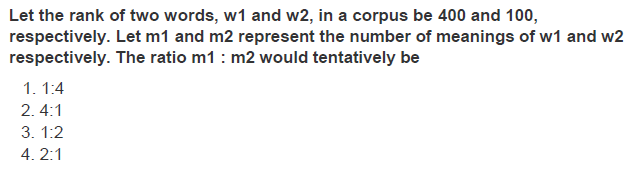
Answer :- 3
4.
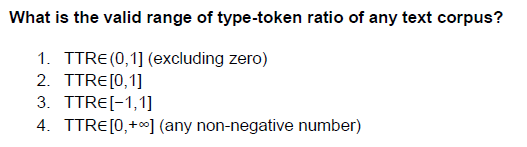
Answer :- 1
5.
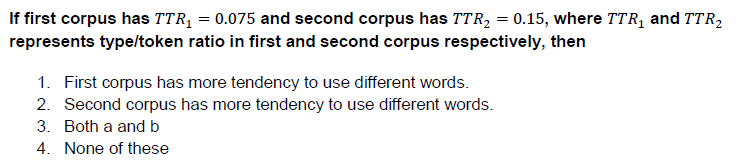
Answer :- 2
6.
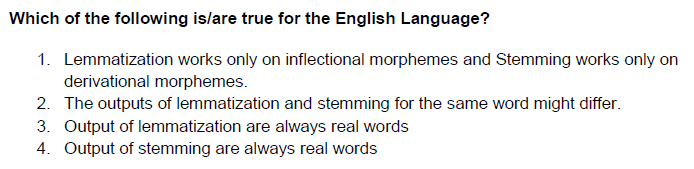
Answer :- 2,3
7.
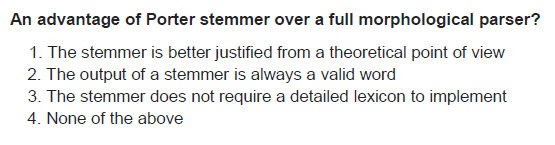
Answer :- 3
8.
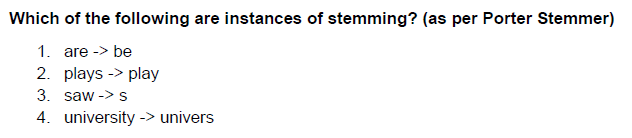
Answer :- 2, 4
9.
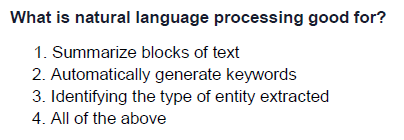
Answer :- 4
10.
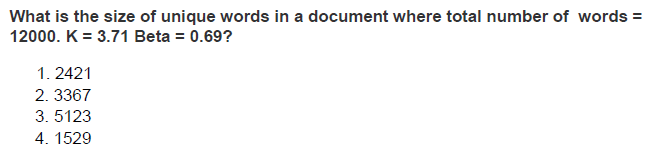
Answer :- 1