
1. Which of the following is a supervised learning problem?
- Grouping people in a social network.
- Predicting credit approval based on historical data
- Predicting rainfall based on historical data
- all of the above
Answer : b, c
2. Which of the following are classification problems? (multiple options may be correct)
- Predicting the temperature (in Celsius) of a room from other environmental features (such as atmospheric pressure, humidity etc).
- Predicting if a cricket player is a batsman or bowler given his playing records.
- Predicting if a particular route between two points has traffic jam or not based on the travel time of vehicles.
- Filtering of spam messages
Answer : b, c, d
3. Which of the following is a regression task? (multiple options may be correct)
- Predicting the monthly sales of a cloth store in rupees.
- Predicting if a user would like to listen to a newly released song or not based on historical data.
- Predicting the confirmation probability (in fraction) of your train ticket whose current status is waiting list based on historical data.
- Predicting if a patient has diabetes or not based on historical medical records.
- Predicting the gender of a human based on facial features.
Answer : a, c
4. Which of the following is an unsupervised task?
- Learning to play chess.
- Predicting if a new edible item is sweet or spicy based on the information of the ingredients, their quantities, and labels (sweet or spicy) for many other similar dishes.
- Grouping related documents from an unannotated corpus.
- all of the above
Answer : c
5. Which of the following is a categorical feature?
- Number of legs of an animal
- Number of hours you study in a day
- Your weekly expenditure in rupees.
- Branch of an engineering student
- Ethnicity of a person
- Height of a person in inches
Answer : d, e
6. Let X and Y be a uniformly distributed random variable over the interval [0, 4] and [0, 6] respectively. If X and Y are independent events, then compute the probability, P (max(X, Y ) > 2)
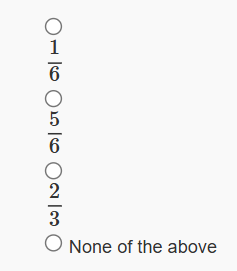
Answer : b
7.
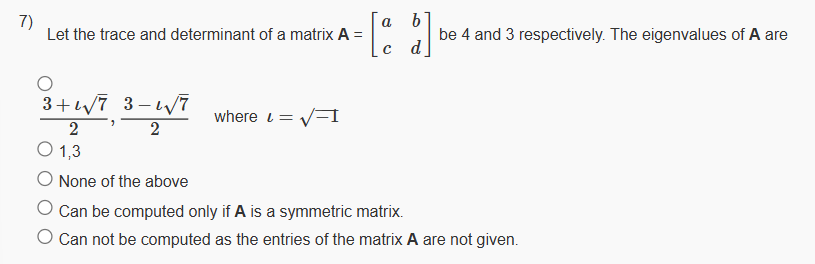
Answer : b
8. What happens when your model complexity increases? (multiple options may be correct)
- Model Bias decreases
- Model Bias increases
- Variance of the model decreases
- Variance of the model increases
Answer : a, d
9. Based on a survey, it was found that the probability that a student likes to play football was 0.25 and the probability that a student likes to play cricket is 0.43. It was also found that the probability that a student likes to play both football and cricket is 0.12. What is the probability that a student does not like to play either?
- 0.32
- 0.2
- 0.44
- 0.56
Answer : c
10. Which of the following are true about bias and variance of overfitted and underfitted models? (multiple options may be correct)
- Underfitted models have high bias.
- Underfitted models have low bias.
- Overfitted models have low variance.
- Overfitted models have high variance.
- none of these
Answer : a, d