
Introduction to Operating Systems Week 5 NPTEL Assignment Answers 2025
Need help with this week’s assignment? Get detailed and trusted solutions for Introduction to Operating Systems Week 5 NPTEL Assignment Answers. Our expert-curated answers help you solve your assignments faster while deepening your conceptual clarity.
✅ Subject: Introduction to Operating Systems
📅 Week: 5
🎯 Session: NPTEL 2025 July-October
🔗 Course Link: Click Here
🔍 Reliability: Verified and expert-reviewed answers
📌 Trusted By: 5000+ Students
For complete and in-depth solutions to all weekly assignments, check out 👉 NPTEL Introduction to Operating Systems Week 5 NPTEL Assignment Answers
🚀 Stay ahead in your NPTEL journey with fresh, updated solutions every week!
NPTEL Introduction to Operating Systems Week 5 Assignment Answers 2025
1. The data structure best suitable for implementing Round Robin Scheduling is
- Stack
- Queue
- List
- Array
Answer : See Answers
2. What does Turn around time mean ?
- Time from the process enters the ready queue to the time it starts execution
- The difference between the arrival time and the completion time of the process
- Time taken from start to completion of I/O
- Time a process waits in the ready queue
Answer :
3. a. O(n) scheduler 1)has 2 run queues to prevent starvation b. O(1) scheduler 2)Set based on priority of the process c. Time Slice of a process 3)is based on average sleeping time d. Dynamic Priority 4) Not scalable to large number of processes
- a-3, b-1 c-4, d-2
- a-3, b-4,c-1, d-3
- a-4, b-1, c-2, d-3
- a-4, b-3, c-2, d -1
Answer :
4. Preemption is
- forced deallocation of the CPU from a program which is executing on the CPU
- release of CPU by the program after completing its task
- forced allocation of CPU by a program to itself
- a program terminating itself due to detection of an error
Answer :
5. Which of the following scheduling algorithms is not preemptive?
- FCFS
- Round robin
- SRTF
- Ideal Fair scheduling
Answer :



6. State if the following statement is True or False.
A system can have more than one scheduling algorithm at a time- True
- False
Answer : See Answers
7. Shortest Remaining Time first algorithm is not practical
    a. Its time complexity is huge, which makes it unsuitable for real systems
b. It requires knowledge of the burst time, which is not easy to predict- True,True
- True,False
- False,True
- False,False
Answer :
8.
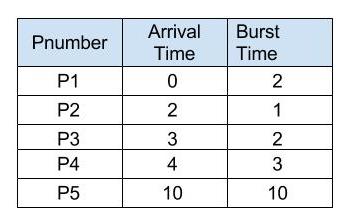
Answer the following questions (8 and 9)
What is the Schedule length of the following process.(used FCFS scheduling)
- 10
- 16
- 19
- 20
Answer :
9. With respect to the table given above, which of the following is False?
- The order of execution is same in FCFS and SRTF
- The average waiting time is same for FCFS and SJF
- The CPU idle time is 2 units
- None of these
Answer :
10. Consider a set of process A, B, C, D arriving in the same order at time zero in the ready queue. Their burst times are 4, 1, 8, 1 respectively. Using Round Robin scheduling, with time slice of 1 unit. What is the time at which process A completes execution?
- 4
- 5
- 9
- 12
Answer : See Answers
11. Consider three process P1, P2, and P3 with arrival time (0, 1, 3) and burst time (6 ,5,4) respectively, what is the order of completion in SJF and RR scheduling with time slice of 2 units
- SJF: P1 P3 P2 RR: P1 P2 P3
- SJF: P1 P2 P3 RR: P1 P2 P3
- SJF: P1 P2 P3 RR: P2 P1 P3
- SJF: P1 P3 P2 RR: P1 P3 P2
Answer :
12. Let the base priority of a system be 130 and the nice value provided is -10. What is the time slice that the process gets in the O(1) scheduling algorithm?
- 100
- 200
- 300
- 400
Answer :
13. Consider 3 Process, arriving at time zero, with total execution time of 40, 50, 60 ms respectively. Each process spends the first 40% of execution time doing I/O operation and the next 60% time for computations. The scheduler uses FCFS scheduling. Assuming that all I/O operations are overlapped. How much time in ms the CPU is idle?
- 16 ms
- 24ms
- 60ms
- None of these
Answer :
14. From the data given in Question 13, what is the average turn around time?
- 32 ms
- 48 ms
- 52 ms
- 72 ms
Answer :
15. A process is provided with a bonus of 4 in the O(1) scheduling algorithm. The dynamic priority of the process ______________.
Answer : See Answers