
Software Testing Week 4 NPTEL Assignment Answers 2025
Need help with this week’s assignment? Get detailed and trusted solutions for Software Testing Week 4 NPTEL Assignment Answers. Our expert-curated answers help you solve your assignments faster while deepening your conceptual clarity.
✅ Subject: Software Testing
📅 Week: 4
🎯 Session: NPTEL 2025 July-October
🔗 Course Link: Click Here
🔍 Reliability: Verified and expert-reviewed answers
📌 Trusted By: 5000+ Students
For complete and in-depth solutions to all weekly assignments, check out 👉 NPTEL Software Testing Week 4 NPTEL Assignment Answers
🚀 Stay ahead in your NPTEL journey with fresh, updated solutions every week!
NPTEL Software Testing Week 4 Assignment Answers 2025
1. Which of the following best describes a test driver?
- It is a special purpose implementation of a software module, used to develop or test a component that calls it.
- It is a software component that replaces another component that takes care of the control and/or the calling of a software component.
Answer : See Answers
2. If method A uses a variable v shared with method B, where A writes to v and B reads from v, then, it is an example of which kind of coupling interface listed below?
- Parameter coupling.
- Interface coupling.
- External coupling.
- Shared data coupling.
Answer :
3. To test sequencing constraints that occur as requirements specification, which of the following tests are used?
- Tests are inputs to sequencing constraints that violate the constraints.
- Tests are inputs to sequencing constraints that satisfy the constraints.
- Tests are sequences of method calls, as they occur in the specification.
- Tests are randomly generated sequencing constraints.
Answer :
4. A simple path from the last definition to the first use of a coupling variable is called as . . . . . . . . ..
- A du-path.
- A coupling du-path.
Answer :


![[Week 1-4] NPTEL Software Testing Assignment Answers 2025](https://answergpt.in/wp-content/uploads/2025/01/Software-Testing-2025.jpg)

5. State Yes or No: Are control flow graphs representing code the same as finite state machines that represent the same code?
- Yes
- No
Answer :
Consider the graph below that depicts the calls to file handler methods open(), close(),read() and write(). Any procedure/method that uses these methods has to satisfy the following sequencing constraints: (1) An open(f) must be executed before every write(t), (2) An open(f) must be executed before every close(), (3) A write(f) may not be executed after a close() unless there is an open(f) in between, (4) A write(t) should be executed before every close().
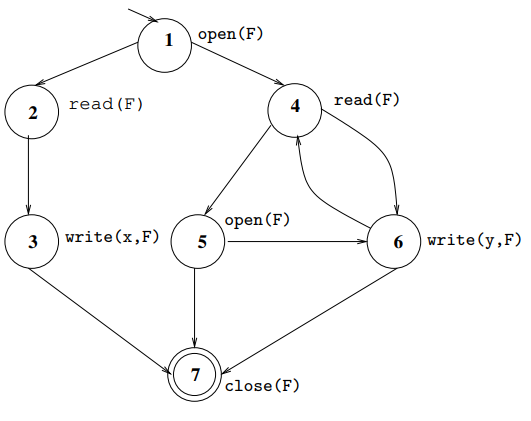
Answer the following questions with reference to the sequencing constraints and the graph a method that uses these constraints.
6. Which of the following is true with reference to the graph satisfying the sequencing constraints?
- All the sequencing constraints are satisfied.
- Constraints (1) and (2) are satisfied but (3) and (4) are not.
- Constraints (1), (2) and (3) are satisfied but (4) is not.
- All constraints are violated.
Answer : See Answers
7. State true or false: The path (1,4,5,7) satisfies constraint (4).
- True.
- False.
Answer :
8. State true or false: The path (1,2,3,7) satisfies all the constraints.
- True.
- False.
Answer :
9. State yes or no: Does the path (1,4,6,7) violate any of the constraints?
- Yes.
- No.
Answer :
10. State true or false: The path (1,4,6,4,6,7) satisfies all the constraints.
- Yes.
- No.
Answer : See Answers