The Joy of Computing using Python Week 1 NPTEL Assignment Answers 2026
Need help with this week’s assignment? Get detailed and trusted solutions for The Joy of Computing using Python Week 1 NPTEL Assignment Answers. Our expert-curated answers help you solve your assignments faster while deepening your conceptual clarity.
✅ Subject: The Joy of Computing using Python
📅 Week: 1
🎯 Session: NPTEL 2026 (January To April)
🔗 Course Link: Click Here
🔍 Reliability: Verified and expert-reviewed answers
📌 Trusted By: 5000+ Students
For complete and in-depth solutions to all weekly assignments, check out 👉 NPTEL The Joy of Computing using Python Week 1 NPTEL Assignment Answers
🚀 Stay ahead in your NPTEL journey with fresh, updated solutions every week!
The Joy of Computing using Python Week 1 NPTEL Assignment Answers 2026
1. What will be the final value of counter after the program finishes execution?
- 8
- 5
- 3
- 10
Answer : See Answers
2. What will be the value of score after the first repeat loop ends?
- 20
- 24
- 40
- 44
Answer :
3. What is the final value of score that the sprite will say?
- 22
- 28
- 34
- 40
Answer :
4. How many times in total is the change counter by 1 block executed?
- 3
- 5
- 6
- 8
Answer :


![[Week 1-12] NPTEL The Joy of Computing using Python Assignment Answers 2025](https://answergpt.in/wp-content/uploads/2025/01/The-Joy-of-Computing-using-Python-2025.jpg)

![[Week 1-12] NPTEL The Joy of Computing using Python Assignment Answers 2026](https://answergpt.in/wp-content/uploads/2026/01/NPTEL-The-Joy-of-Computing-using-Python-Assignment-Answers-2026.jpg)
![PYQ [Week 1-12] NPTEL The Joy Of Computing Using Python Assignment Answer 2023](https://answergpt.in/wp-content/uploads/2024/01/NPTEL-The-Joy-Of-Computing-Using-Python-Assignment-Answer-2023.png)
5. Which statement is TRUE about the execution of this Scratch program?
- The value of score is reset before the second loop
- The second loop runs before the first loop
- The sprite says the value of score only once
- The variable counter is updated only in one loop
Answer : See Answers
6. What will be the final value of counter after the program finishes execution?
- 5
- 6
- 8
- 12
Answer :
7. What will be the value of score immediately after the repeat loop ends (before adding bonus)?
- 30
- 36
- 42
- 54
Answer :
8. What will be the final value of bonus after the loop completes?
- 6
- 9
- 12
- 15
Answer :
9. What is the final value of score after the bonus is added?
- 42
- 48
- 50
- 54
Answer : See Answers
10. What message will the sprite display at the end of the program?
- Excellent!
- Level Cleared!
- Try Again!
- No message
Answer :
11. What will be the final value of battery when the loop stops?
- 18
- 14
- 10
- 6
Answer :
12. How many times does the repeat until loop execute?
- 4
- 5
- 6
- 7
Answer :
13. What will be the final value of cycles after the program finishes?
- 5
- 4
- 6
- 8
Answer :
14. Which statement about the repeat until block is TRUE in Scratch?
- The loop always runs at least once
- The loop checks the condition after executing the body
- The loop behaves exactly like repeat n times
- The loop stops immediately if the condition is already true
Answer :
15. What message will the sprite display at the end of the program?
- Battery Low
- System Shutdown
- Recharge Needed
- No message
Answer : See Answers
NPTEL The Joy of Computing using Python Week 1 Assignment Answers 2024
1. Which of the following best defines a variable in programming?
- A constant value that cannot be changed during program execution.
- A named storage location that can hold varying data during program execution.
- An operation that performs arithmetic calculations on data.
- A reserved word is used to define a function or method in a program.
Answer: B
Explanation: A variable is a named memory location that can store data which may change during program execution.
2. Humans easily get bored doing a repetitive job. However, computers are masters of iteration. In programming, we get a control structure that allows a set of instructions to be executed repeatedly based on a condition. It enables automating repetitive tasks by iterating through a block of code until a specific condition is met or for a defined number of times. What is this control structure called?
- Variable
- Operator
- Loop
- Data Type
Answer: C
Explanation: A loop is used to repeat a block of code multiple times until a condition is met, making it ideal for repetitive tasks.
3. Programming logic is different from programming language. Programming languages are many, but programming logic almost remains the same across all programming languages. Which of the following is programming logic?
- Python
- C
- C++
- None of the above
Answer: D
Explanation: Programming logic refers to the reasoning and flow of control in a program, not the language itself.
4. Open-source software, unlike proprietary software, is computer software developed through public, collaborative efforts and made freely available to the public. Which of the following programming languages is/are open source?
- Java
- Python
- FORTRAN
- Perl
Answer: A, B, C, D
Explanation: All these languages have open-source versions or implementations available and are widely used in public development.
5. Knowing how to write a piece of code could help us get things done fast. Choose the areas where we can implement coding.
- Physics
- Mathematics
- Economics
- Small Scale Business
Answer: A, B, C, D
Explanation: Coding is applicable in all these fields for automation, modeling, data analysis, and software solutions.
6. The block of code displayed here is meant for the cat, what is the functionality of this code?
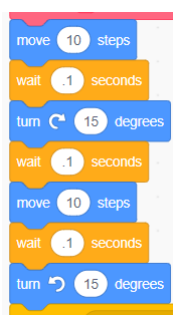
- It brings the ball closer to the cat.
- It makes the cat appear like kicking the ball.
- It makes the cat tumble and rotate
- The code throws an error.
Answer: B
Explanation: Based on the description, the code likely animates the cat in a way that looks like it kicks the ball.
7. The block of code displayed here makes the cat rotate out of impact from the boomeranging ball, how many complete rotations does the cat make?
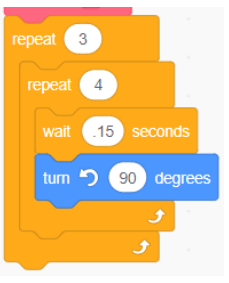
- One
- Two
- Three
- Four
Answer: C
Explanation: The loop and rotation instructions result in three full 360-degree rotations of the cat.
8. The block of code displayed here makes the cat rotate out of impact from the boomeranging ball, how many loops are there in total?

- One
- Two
- Three
- Four
Answer: B
Explanation: Two loop structures are likely nested or sequentially used in the script for the rotation effect.
9. The block of code displayed here is meant for the ball, how many loops are there in total?

- One
- Two
- Three
- Four
Answer: A
Explanation: Only a single loop is used to control the ball’s movement, probably to make it boomerang once.
10. The block of code displayed here is meant for the ball, if the value beside repeat would have been 1 instead of 2, Select all the statements that explain the situation.

- The Ball would not have returned to Cat.
- Removing the loop from the code would have made no difference in the result.
- The Ball would not have left its original position.
- The code would throw an error
Answer: A, B
Explanation: With just one repeat, the ball might move in only one direction and not return; the loop has limited impact if just once; the code would still execute, so no error occurs.