
Artificial Intelligence: Search Methods for Problem Solving Week 2 NPTEL Assignment Answers 2025
NPTEL Artificial Intelligence: Search Methods for Problem Solving Week 2 Assignment 1 Answers 2025
1. What information is available in Week 2 notes (bunch of PDFs) published in the course page?
- About node order and tie breaker
- How to model a problem as a state space search problem
- Some properties of state spaces
- DFS, BFS, DBDFS algorithms and ancillary functions
- DFID-N, DFID-C algorithms and ancillary functions
- Examples of list and tuple operations
- Solved lecture examples
- Solutions to practice assignment problems
- Some problems to demonstrate node order
Answer : For Answers Click Here
Background:
Inspired by Pallanguzhi, a two-person game played in Tamil Nadu, Kerala, Sri Lanka and Malaysia.
There are three cups A, B, C, where each cup holds zero or more shells (or seeds).
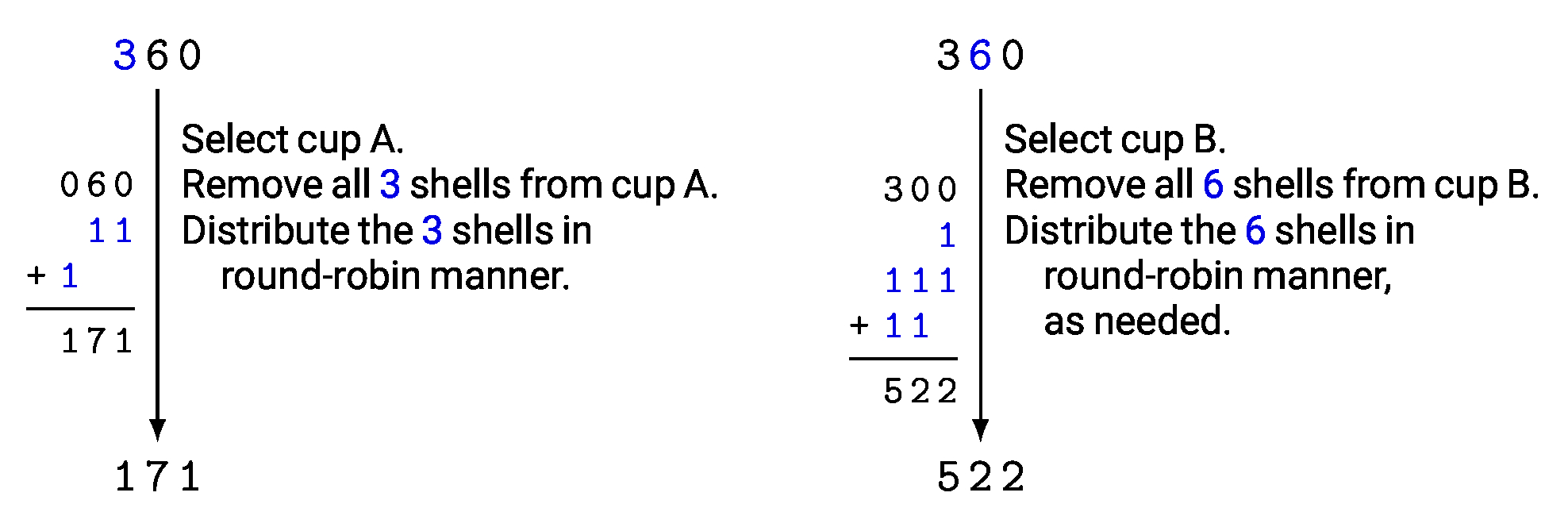
A single move has three steps: (1.) select a non-empty cup, (2.) remove all shells from that cup and (3.) distribute those shells in a round-robin manner. For example, select cup A, remove all shells from cup A (say N shells) then add one shell to each cup in round-robin sequence B, C, A, B, C, A, …, until all N shells are placed.
If you select cup A, follow the round-robin sequence B, C, A, B, C, A, …
If you select cup B, follow the round-robin sequence C, A, B, C, A, B, …
If you select cup C, follow the round-robin sequence A, B, C, A, B, C, …
A state is represented by a three digit number “abc” where digits a, b and c respectively indicate the number of shells in cups A, B and C. For example, “360” is a state where cup A has 3 shells, cup B has 6 shells and cup C is empty, and MoveGen(360) = [171, 522].
State Space 34:
Begin from state “004”, discover the neighbours of “004” (call MoveGen(004)). For each new state x discovered, call MoveGen(x) to generate x’s neighbours, and repeat until no more new states are discovered. The state space graph from such a process is depicted here (call it Graph-34, a graphical representation of State Space 34).

2. Which of the following are valid states in State Space 34?
- 400
- 360
- 212
- 202
Answer : For Answers Click Here
3. From the state 121 which of the following states can be reached in exactly one move?
- 013
- 031
- 202
- 220
- 310
- 400
Answer :
4. From which of the following states can we reach the state 121 in exactly one move?
- 013
- 031
- 202
- 220
- 310
- 400
Answer :
5. From the state 004 the minimum number of moves required to reach 400 is ______________.
Answer :
6. State true or false. In State Space 34, there exists a pair of states X and Y such that MoveGen(X) contains Y and MoveGen(Y) contains X.
- True
- False
- Cannot be determined
Answer :
7. Given that, a node represents a state and an edge represents a state transition. State true or false. Every edge in Graph 34 is a two-way edge.
- True
- False
- Cannot be determined
Answer : For Answers Click Here
8. State true or false. In State Space 34, every state is reachable from every other state in one of more moves.
- True
- False
- Cannot be determined
Answer :
9. Select the true statements.
- All states and state transitions in Graph 34 are valid.
- At least one state transition in Graph 34 is incorrect.
Answer :
10. Select the true statements.
- All states from State Space 34 are present in Graph 34.
- At least one state from State Space 34 is absent in Graph 34.
Answer :
NPTEL Artificial Intelligence: Search Methods for Problem Solving Week 2 Assignment 2 Answers 2025
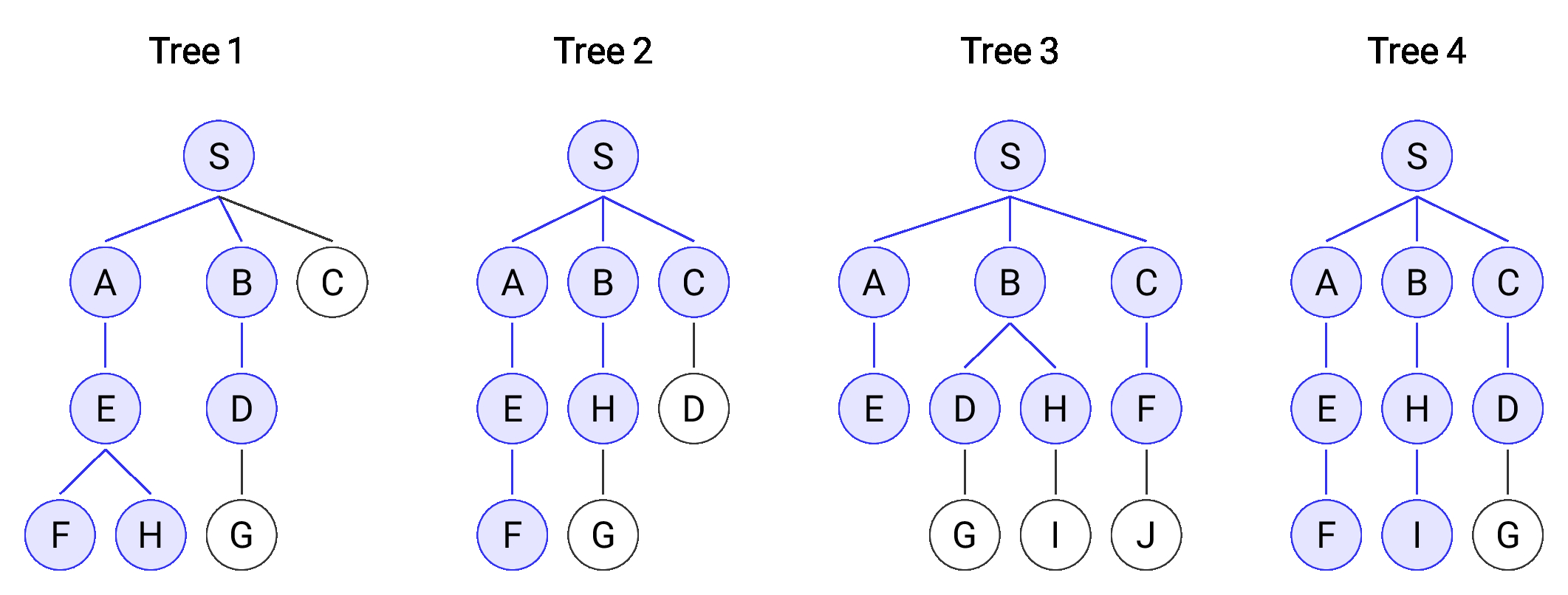
1. The BFS search tree is ____________.
- Tree 1
- Tree 2
- Tree 3
- Tree 4
Answer :
2. When BFS finds the goal node, i.e., when GoalTest returns true, the NODEs present in OPEN list are __ .
The OPEN list contains pairs (NODE,PARENT), ignore the PARENTs and list only the NODEs in the order it occurs in the OPEN list (head to tail).
Answer :
3. List the nodes inspected by BFS. Enter the nodes in the order they were inspected.
Answer :
4. What is the path found by BFS?
Answer :
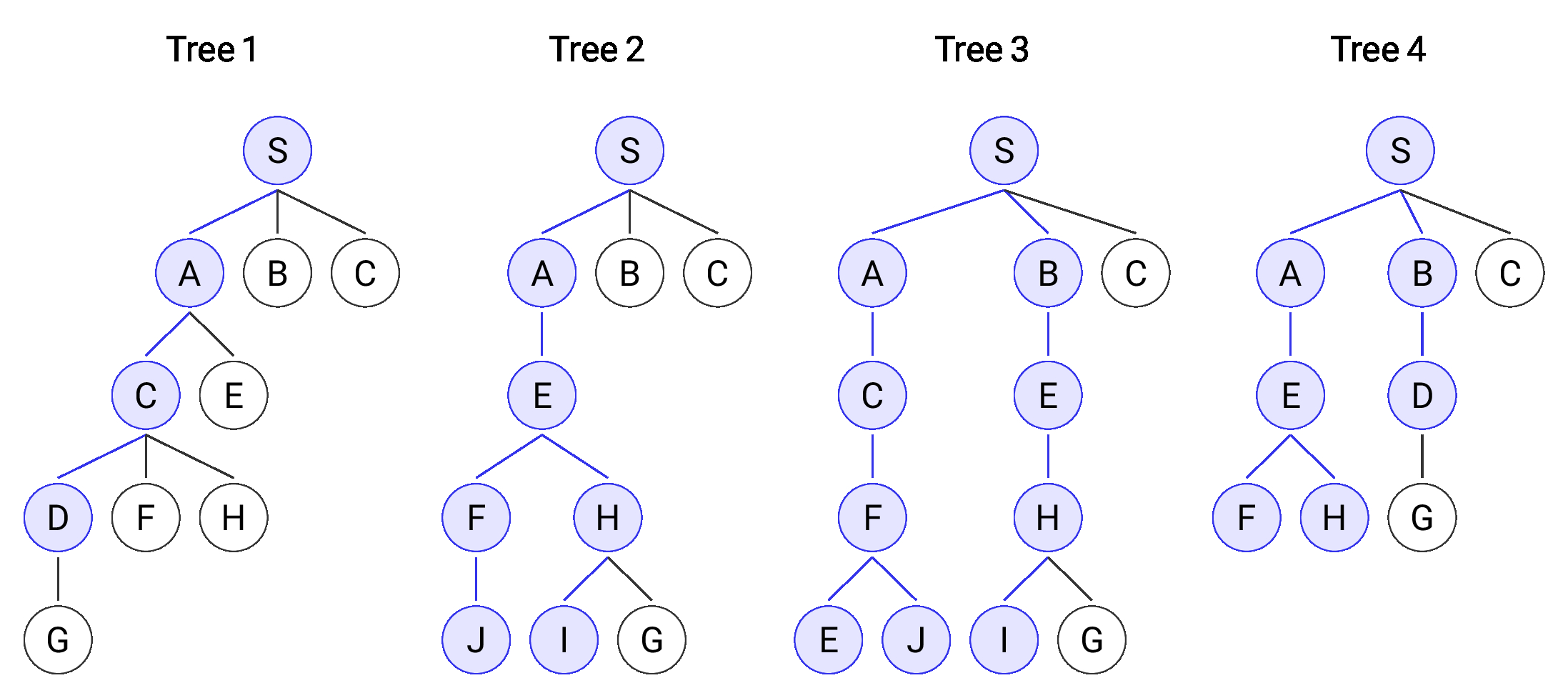
5. The DFS search tree is ____________.
- Tree 1
- Tree 2
- Tree 3
- Tree 4
Answer :
6. When DFS finds the goal node, i.e., when GoalTest returns true, the NODEs present in OPEN list are __ .
The OPEN list contains pairs (NODE,PARENT), ignore the PARENTs and list only the NODEs in the order it occurs in the OPEN list (head to tail).
Answer :
7. List the nodes inspected by DFS. Enter the nodes in the order they were inspected.
Answer :
8. What is the path found by DFS?
Answer :
9. When DBDFS (depthBound=3) finds the goal node, i.e., when GoalTest returns true, the NODEs present in OPEN list are ________________.
Answer :
10. List the nodes inspected by DBDFS (depthBound=3). Enter the nodes in the order they were inspected.
Answer :
11. What is the path found by DBDFS (depthBound=3)?
Answer :
12. What data structure is used to store the OPEN nodes in Breadth First Search and Depth First Search, respectively?
- List and List
- Queue and Stack
- Stack and Queue
- Tree and Tree
Answer :