
Deep Learning – IIT Ropar Week 1 NPTEL Assignment Answers 2026
Need help with this week’s assignment? Get detailed and trusted solutions for Deep Learning – IIT Ropar Week 1 NPTEL Assignment Answers. Our expert-curated answers help you solve your assignments faster while deepening your conceptual clarity.
✅ Subject: Deep Learning – IIT Ropar
📅 Week: 1
🎯 Session: NPTEL 2026 January-April
🔗 Course Link: Click Here
🔍 Reliability: Verified and expert-reviewed answers
📌 Trusted By: 5000+ Students
For complete and in-depth solutions to all weekly assignments, check out 👉 NPTEL Deep Learning – IIT Ropar Week 1 NPTEL Assignment Answers
🚀 Stay ahead in your NPTEL journey with fresh, updated solutions every week!
NPTEL Deep Learning – IIT Ropar Week 1 Assignment Answers 2026
1. What value of θ correctly implements the specified alarm behavior?
- 1
- 2
- 3
- 4
Answer : For Answers Click Here
2. Which of the following sensor activation patterns will result in an alarm signal?
Select all that apply.
- (1, 1, 1, 0)
- (0, 1, 1, 1)
- (1, 0, 0, 1)
- (1, 1, 1, 1)
- (0, 0, 1, 1)
Answer :
3. Fill the blank with correct answer
The total number of sensor input combinations that trigger the alarm is: _______________
Answer :
4. Which of the following statements about the alarm logic are correct?
- The set of alarm-triggering input patterns is linearly separable
- The alarm behavior can be implemented using a single threshold unit
- Exactly half of all possible input combinations result in an alarm
- Increasing the threshold beyond the chosen value increases resistance to isolated sensor noise
- The alarm output depends on the sequence in which sensor inputs arrive
Answer : For Answers Click Here
![[Week 1-12] NPTEL Deep Learning – IIT Ropar Assignment Answers 2026](https://answergpt.in/wp-content/uploads/2026/01/NPTEL-Deep-Learning-IIT-Ropar-Assignment-Answers-2026.jpg)


![[Week 1-12] NPTEL Deep Learning – IIT Ropar Assignment Answers 2025](https://answergpt.in/wp-content/uploads/2025/01/Week-1-12-NPTEL-Deep-Learning-IIT-Ropar-Assignment-Answers-2025.png)


![[Week 1-12] NPTEL Deep Learning – IIT Ropar Assignment Answers 2024](https://answergpt.in/wp-content/uploads/2024/01/NPTEL-Deep-Learning-–-IIT-Ropar-Assignment-Answers-2024.jpeg)
5. If the threshold were incorrectly set to θ=2, which outcome would most likely occur?
- The alarm would never activate
- The alarm would activate only when all sensors are active
- The alarm would activate more frequently, increasing false positives
- The alarm behavior would become undefined
Answer :
6. The anchor-pattern mapping in the table corresponds to which logical behavior of(x1,x2) (treating 1 as “high” and 0 as “low”)?
- AND
- OR
- XOR
- XNOR
Answer :
7. Can a single linear-threshold classifier of the form w1x1+w2x2+b≥0 correctly classify all four anchor patterns shown?
- Yes, always
- Yes, but only if b=0
- No
- Yes, but only if w1=w2
Answer :
8. Suppose the team insists on using a single linear-threshold model and chooses parameters w1=1,w2=1
and b=−1 Which anchor groups will be predicted as y^=1
- Only G4
- G2 and G3
- Only G2
- G2, G3, and G4
Answer :
9. Fill in the blank
For the model in the previous question (w1=1,w2=1 and b=−1), how many of the four anchor patterns are classified correctly? _______
Answer :
10. A two-unit deterministic system is proposed:
Unit U1 outputs 1 if x1+x2≥1, Unit U2 outputs 1 if x1+x2≥2. Final output is y=1 if U1=1 and U2=0, else y=0
Which anchor inputs will this system classify as y=1?
Select all that apply.
- (0,0)
- (0,1)
- (1,0)
- (1,1)
Answer : For Answers Click Here
11. Which logical condition best describes the accept decision specified in the policy?
- x3∧(x1∨x2∨x4)
- (x1∧x2)∨(x3∧x4)
- x3⊕(x1∨x2∨x4)
- (x1∨x2∨x3∨x4)
Answer :
12. Why does a single linear-threshold rule fail to implement the specified policy for all inputs?
- The input dimension is too high
- The policy induces non-linearly separable input patterns
- The features are binary
- The bias term is missing
Answer :
13. Which of the following input patterns must result in y=1 under the policy? Select all that apply
(Inputs listed as (x1,x2,x3,x4)
- (0,0,1,1)
- (1,0,1,0)
- (0,0,0,1)
- (0,1,0,0)
- (0,0,1,0)
Answer :
14. How many distinct input combinations produce y=1 under the stated policy?
- 3
- 5
- 7
- 9
Answer :
15. Which of the following statements about the hierarchical design are correct?
- It decomposes the decision into linearly separable subproblems
- It can be collapsed into a single equivalent linear-threshold rule
- It correctly implements the specified policy
- It increases representational capacity compared to a single stage
- It requires continuous-valued features
Answer : For Answers Click Here
NPTEL Deep Learning – IIT Ropar Week 1 Assignment Answers 2025
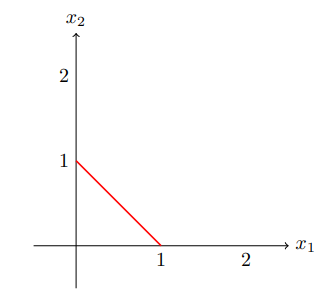
1. Which Boolean function with two inputs x1 and x2 is represented by the following decision boundary? (Points on boundary or right of the decision boundary to be classified 1)
- AND
- OR
- XOR
- NAND
Answer :- b
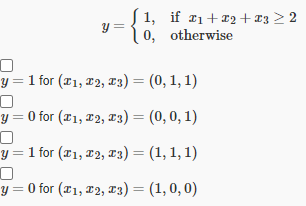
2. Choose the correct input-output pair for the given MP Neuron.
Answer :- a, b, c, d
3. Suppose we have a boolean function that takes 4 inputs x1, x2, x3, x4? We have an MP neuron with parameter θ=2. For how many inputs will this MP neuron give output y=1?
- 11
- 21
- 15
- 8
Answer :- a
4. We are given the following data:
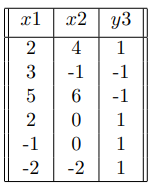
Can you classify every label correctly by training a perceptron algorithm? (assume bias to be 0 while training)
- Yes
- No
Answer :- b
5. We are given the following dataset with features as (x1,x2) and y as the label (-1,1). If we apply the perception algorithm on the following dataset with w initialized as (0,0). What will be the value of w when the algorithm converges? (Start the algorithm from (2,2)
- (-2,2)
- (2,1)
- (2,-1)
- None of These
Answer :- c
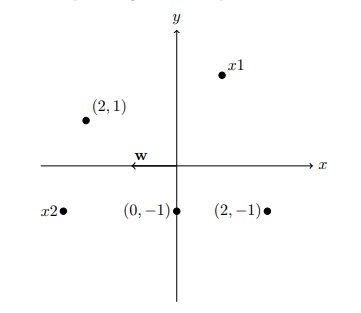
6. Consider points shown in the picture. The vector w is (-1,0). As per this weight vector, the Perceptron algorithm will predict which classes for the data points x1 and x2.
- x1=1
- x2=1
- x1=-1
- x2=-1
Answer :- b, c
7. Given an MP neuron with the inputs as x1,x2,x3,x4,x5 and threshold θ=3 where x5 is inhibitory input. For input (1,1,1,0,1) what will be the value of y?
- y=0
- y=1 since θ≥3
- y=1/2
- Insufficient information
Answer :- a
8. An MP neuron takes two inputs x1 and x2. Its threshold is θ=0. Select all the boolean functions this MP neuron may represent.
- AND
- NOT
- OR
- NOR
Answer :- d
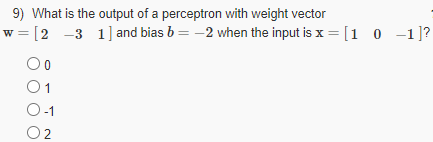
Answer :- c
10. What is the ”winter of AI” referring to in the history of artificial intelligence?
- The period during winter when AI technologies are least effective due to cold temperatures
- A phase marked by decreased funding and interest in AI research.
- The season when AI algorithms perform at their peak efficiency.
- A period characterized by rapid advancements and breakthroughs in AI technologies.
Answer :- c