
Deep Learning Week 1 NPTEL Assignment Answers 2026
1. In the context of a signature descriptor, how is the “signature” of a shape generated?
a. By calculating the Fourier coefficients of the boundary points.
b. By plotting the distance of boundary points from the centroid in various orientations.
c. By recursively subdividing a shape into polygonal segments.
d. None of the above
Answer : See Answers
2. Why is a logarithmic transformation used in the computation of Mel Frequency Cepstral Coefficients (MFCC) for audio signals?
a. To normalize the frequency spectrum.
b. Because the human auditory system is more sensitive to signals that are not very loud.
c. To remove high-frequency noise from the microphone.
d. To convert the signal into a two-dimensional matrix.
Answer :
3. Which of the following is a region descriptor?
a. Polygonal Representation
b. Fourier descriptor
c. Signature
d. Intensity histogram.
Answer :
4. What is the primary difference between Traditional Machine Learning and Deep Learning regarding feature extraction?
a. Traditional machine learning ignores the raw signal.
b. Deep learning requires the user to manually define and extract features before training.
c. In deep learning, the machine learns to extract relevant features directly from the raw signal.
d. Deep learning cannot process audio signals whereas traditional machine learning can.
Answer :
![[Week 1-12] NPTEL Deep Learning Assignment Answers 2026](https://answergpt.in/wp-content/uploads/2026/01/NPTEL-Deep-Learning-Assignment-Answers-2026.jpg)

![[Week 1-12] NPTEL Deep Learning Assignment Answers 2025](https://answergpt.in/wp-content/uploads/2025/01/Deep-Learning-2025.jpg)
![[Week 1-12] NPTEL Deep Learning Assignment Answers 2024](https://answergpt.in/wp-content/uploads/2024/01/NPTEL-Deep-Learning-Assignment-Answers-2024.jpg)
5. In statistical moment calculation for a normalized histogram hr;), what does the second-order moment (k=2) represent?
a. The mean intensity
b. The skewness of the distribution.
c. The maximum probability of the distribution.
d. The variance (spread) of the histogram.
Answer : See Answers
6.
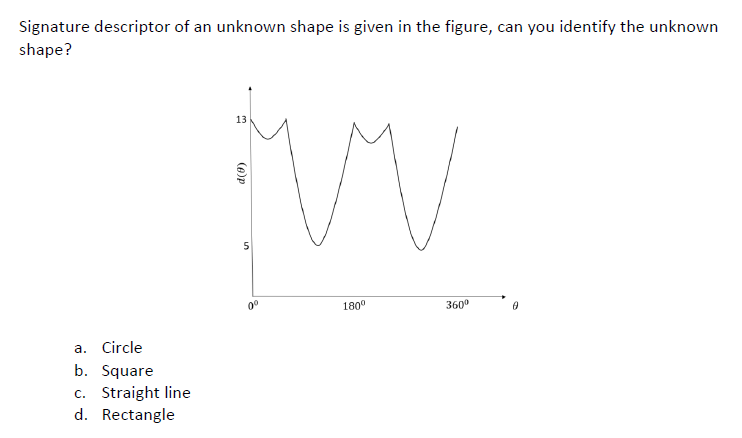
Answer :
7. Under what condition are the Bayes Minimum Risk Classifier and the Bayes Minimum Error Classifier mathematically identical?
a. When the loss function is a one-zero (or zero-one) loss function.
b. When the a priori probabilities of all classes are equal.
c. When the feature space is exactly two-dimensional.
d. When the likelihood ratio is close to 1.
Answer :
8.
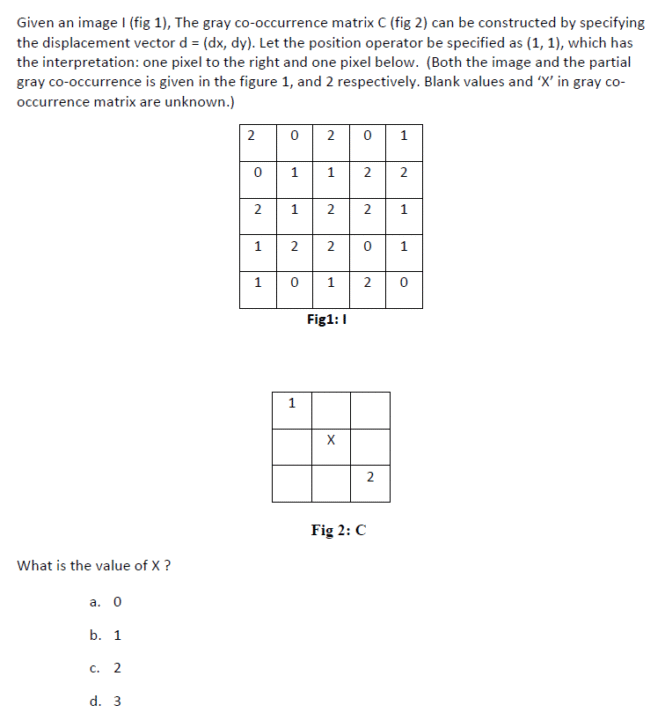
Answer :
9. A sub-segment of an arbitrary object boundary is represented by a discrete boundary function g (ri) after normalization. The distribution of boundary points relative to the centroid is characterized by the following discrete probability mass function:
Discrete radial distances: ri € {2, 4, 6}
Corresponding probabilities: p(2) = 0.25, p(4) = 0.50, p(6) = 0.25 Calculate the second-order statistical moment of this boundary segment
- a. 2
- b. 4
- c. 4.5
- d. 3
Answer :
10. When using Fourier Descriptors to reconstruct a square shape, what is the effect of using only
low-order coefficients (P « N)
a. The reconstructed shape will have sharper corners.
b. The reconstructed shape will lose detailed information (corners) and appear circular.
c. The reconstruction will be identical to the original shape.
d. The reconstruction will result in a single point.
Answer : See Answers
NPTEL Deep Learning Week 1 Assignment Answers 2025
Q1. Which of the following is (are) region descriptor(s)? Choose the correct option.
i) Fourier descriptor ii) co-occurrence matrix iii) Intensity histogram iv) Signature
a. Both I and IV
b. Only 1
с. Both Il and III
d. None of the above
Answer:- c
Q2.

Answer:- c
Q3.

Answer:- c
Q4.

Answer:- a
Q5.
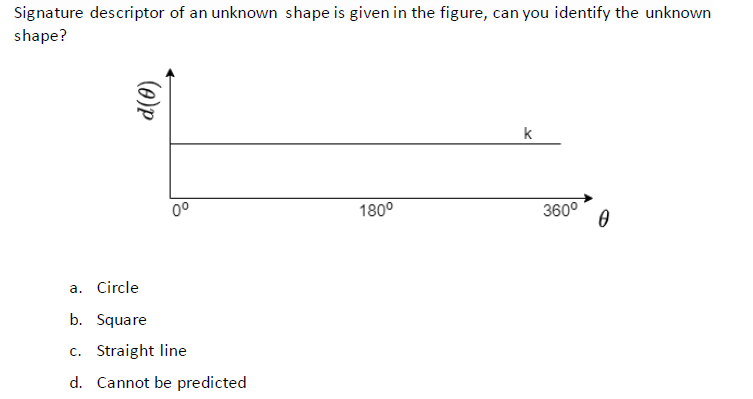
Answer:- a
Q6.

Answer:- d
Q7. Which of the following is not a Co-occurrence matrix-based descriptor?
a. Entropy
b. Uniformity
c. Intensity histogram.
d. All of the above.
Answer:- c
Q8.
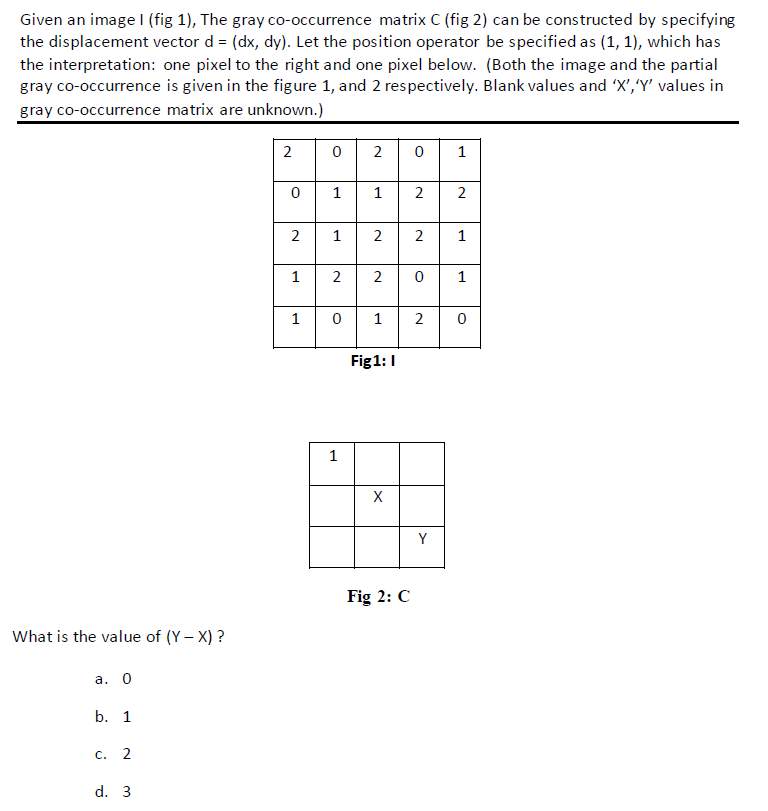
Answer:- d
Q9. What is the value of maximum probability descriptor?
a. 1/4
b. 3/12
c. 1/3
d. 3/16
Answer:- a
Q10. The plot of distance of the different boundary point from the centroid of the shape taken at various direction is known as
a. Signature descriptor
b. Polygonal descriptor
c. Fourier descriptor.
d. Convex Hull
Answer:- a