
Introduction to Machine Learning – IITKGP Week 3 NPTEL Assignment Answers 2025
Need help with this week’s assignment? Get detailed and trusted solutions for Introduction to Machine Learning – IITKGP Week 3 NPTEL Assignment Answers. Our expert-curated answers help you solve your assignments faster while deepening your conceptual clarity.
✅ Subject: Introduction to Machine Learning – IITKGP (nptel ml Answers)
📅 Week: 3
🎯 Session: NPTEL 2025 July-October
🔗 Course Link: Click Here
🔍 Reliability: Verified and expert-reviewed answers
📌 Trusted By: 5000+ Students
For complete and in-depth solutions to all weekly assignments, check out 👉 NPTEL Introduction to Machine Learning – IITKGP Week 3 Assignment Answers
🚀 Stay ahead in your NPTEL journey with fresh, updated solutions every week!
NPTEL Introduction to Machine Learning – IITKGP Week 3 Assignment Answers 2025
1.
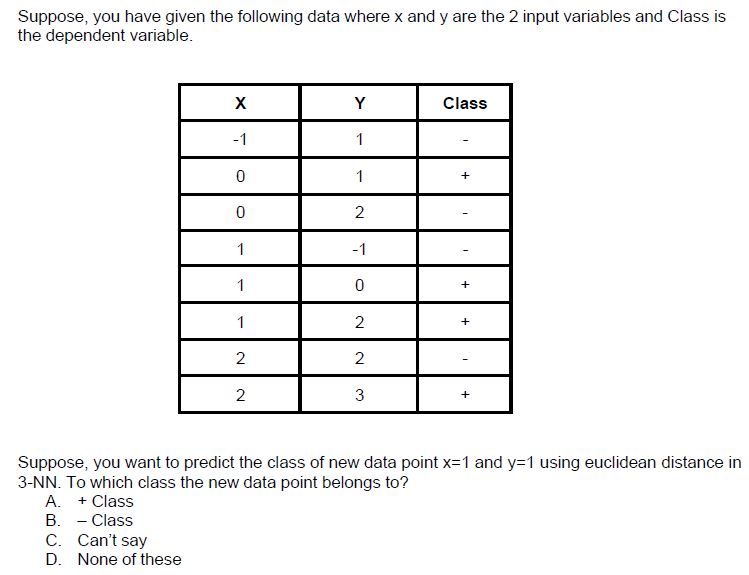
Answer : See Answers
2. Imagine you are dealing with a 10 class classification problem. What is the maximum number of
discriminant vectors that can be produced by LDA?
A. 20
B. 14
C. 9
D. 10
Answer :
3. Fill in the blanks:
K-Nearest Neighbor is a___________,________algorithm
A. Non-parametric, eager
B. Parametric, eager
C. Non-parametric, lazy
D. Parametric, lazy
Answer :
4. Which of the following statements is True about the KNN algorithm?
A. KNN algorithm does more computation on test time rather than train time.
B. KNN algorithm does lesser computation on test time rather than train time.
C. KNN algorithm does an equal amount of computation on test time and train time.
D. None of these.
Answer :




![PYQ [Week 1 to 8] NPTEL Introduction To Machine Learning – IITKGP Assignment Answers 2023](https://answergpt.in/wp-content/uploads/2024/01/NPTEL-Introduction-To-Machine-Learning-–-IITKGP-Assignment-Answers-2023.png)
5. Which of the following necessitates feature reduction in machine learning?
A. Irrelevant and redundant features
B. Curse of dimensionality
C. Limited computational resources.
D. All of the above
Answer :
6. When there is noise in data, which of the following options would improve the performance of the
KNN algorithm?
A. Increase the value of k
B. Decrease the value of k
C. Changing value of k will not change the effect of the noise
D. None of these
Answer : See Answers
7.
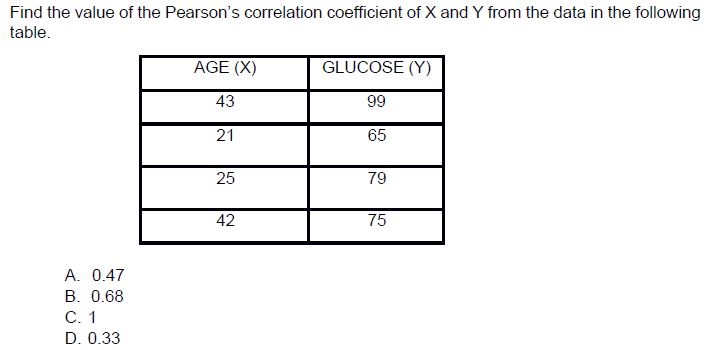
Answer :
8. Which of the following is false about PCA?
A. PCA is a supervised method
B. It identifies the directions that data have the largest variance
C. Maximum number of principal components <= number of features
D. All principal components are orthogonal to each other
Answer :
9. In user-based collaborative filtering based recommendation, the items are recommended based on :
A. Similar users
B. Similar items
C. Both of the above
D. None of the above
Answer :
10. Identify whether the following statement is true or false?
“PCA can be used for projecting and visualizing data in lower dimensions.”
A. TRUE
B. FALSE
Answer : See Answers